fastapi-jsonrpc
JSON-RPC 2.0 server built on top of FastAPI. Write JSON-RPC methods the same way you write FastAPI endpoints — with Pydantic models, dependency injection, typed parameters and async support — and get OpenAPI, Swagger UI and OpenRPC for free.
import fastapi_jsonrpc as jsonrpc
from fastapi import Body

app = jsonrpc.API()
api_v1 = jsonrpc.Entrypoint('/api/v1/jsonrpc')


@api_v1.method()
def echo(data: str = Body(..., examples=['hello'])) -> str:
    return data


app.bind_entrypoint(api_v1)
Run it with uvicorn and open:
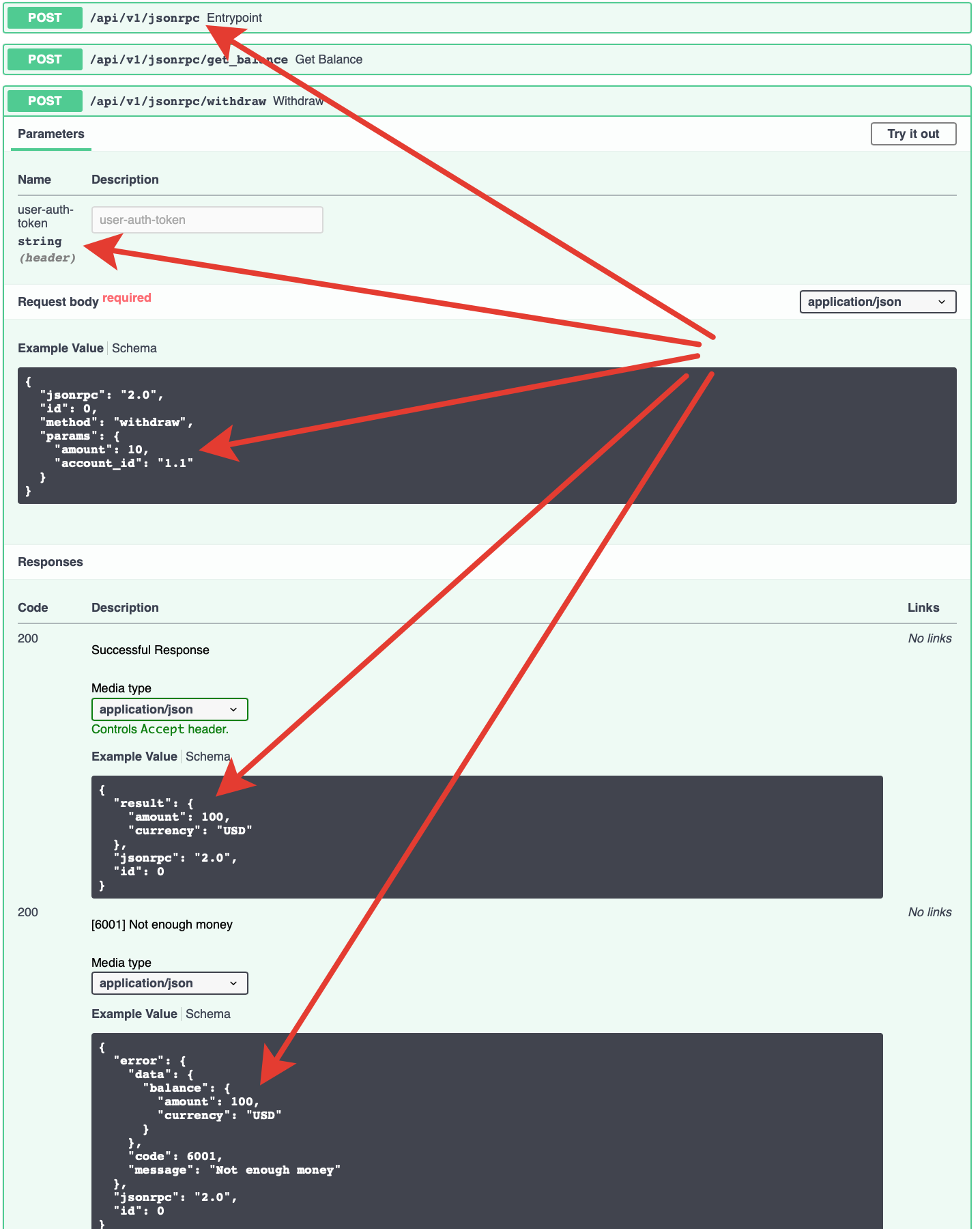
POST /api/v1/jsonrpc— JSON-RPC endpointGET /docs— Swagger UIGET /openapi.json— OpenAPI schemaGET /openrpc.json— OpenRPC schema
Why fastapi-jsonrpc
- All of FastAPI.
Depends,Body,Header,Cookie, Pydantic models,async/await, lifespans, background tasks — everything works the same way inside a JSON-RPC method. - Auto-generated schemas. Each method appears as a regular POST route in the OpenAPI schema, so Swagger UI lets you call methods interactively. OpenRPC schema is generated alongside.
- Typed error model. Errors are plain Python classes with a
CODE,MESSAGEand an optional PydanticDataModel. They end up in the schema automatically. - Batch requests & notifications. Full JSON-RPC 2.0 support — batches, notifications, per-request dependencies.
- JSON-RPC middlewares. Context manager based middlewares with access to the raw request, the raw response and the exception (if any).
- Sentry integration. Optional integration that reports the JSON-RPC method name as the transaction and keeps one Sentry transaction per batch with a span per method.
Where to start
- Installation — install the package.
- Quickstart — a minimal working example in under a minute.
- Methods & parameters — how to declare JSON-RPC methods.
- Errors — custom errors with typed
DataModel. - Dependencies — reuse FastAPI dependencies, including per-batch and per-request.
- Middlewares — cross-cutting concerns around every call.
- OpenAPI & OpenRPC — schemas and interactive docs.
- Sentry — tracing and error reporting.
Looking for deeper details?
A machine-readable, full-detail bundle will be published as llms-full.txt alongside this site. It is intended for LLMs and for offline reading — this site keeps only the essentials.